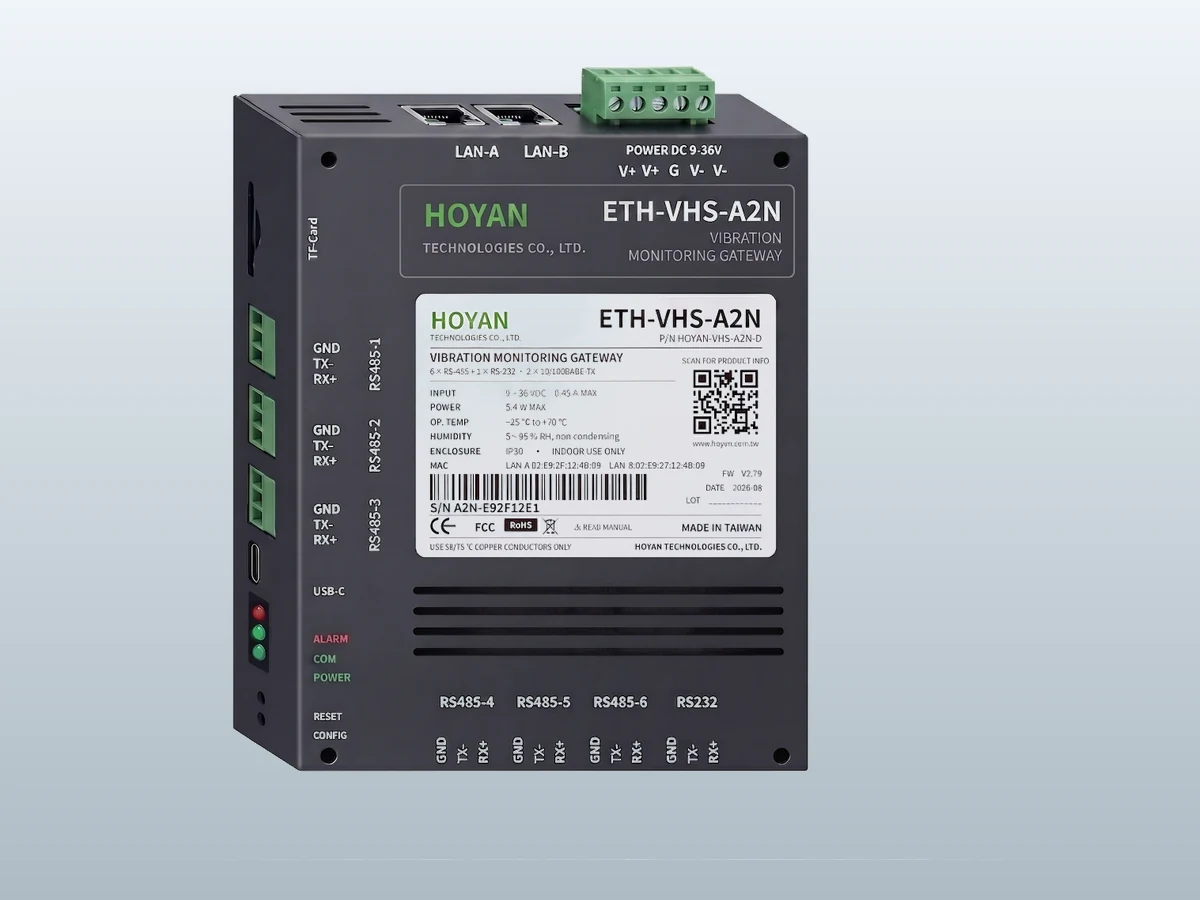
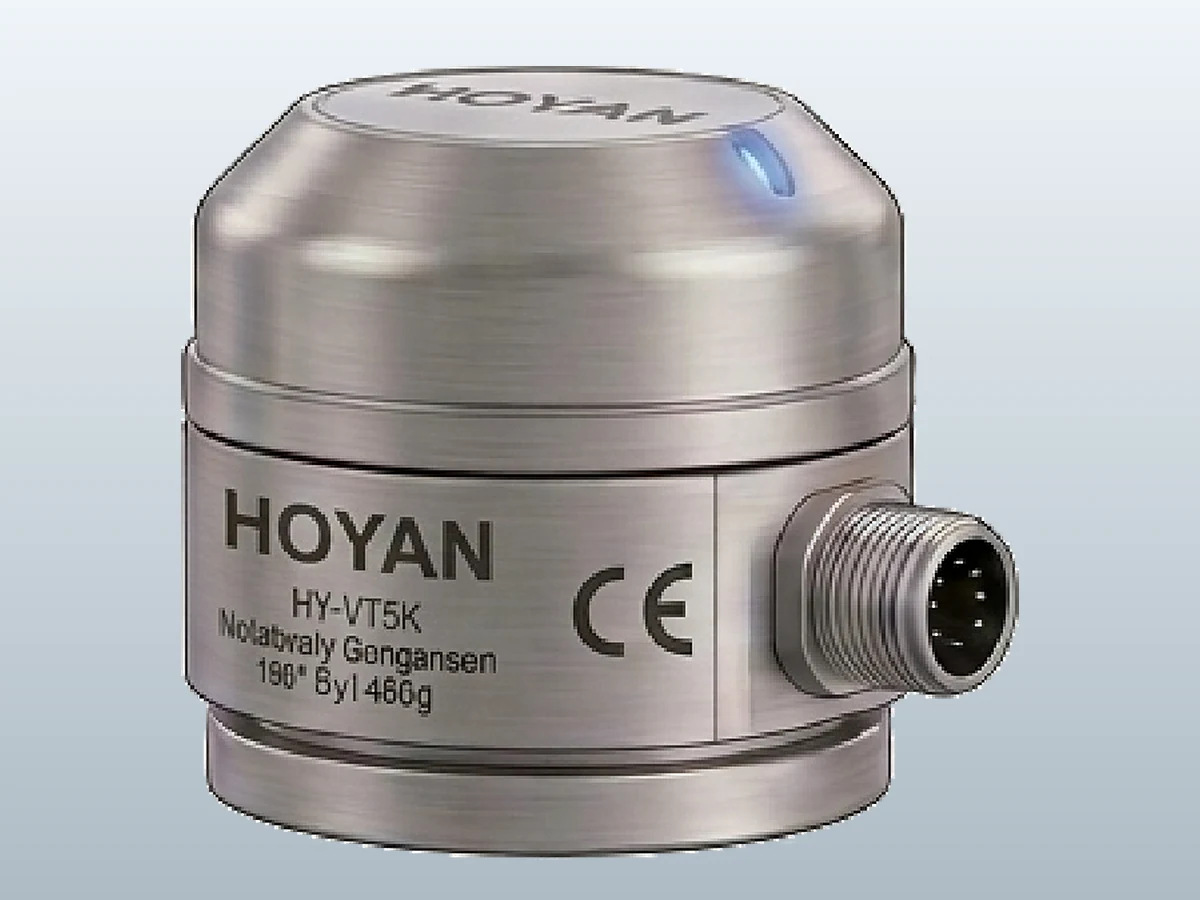
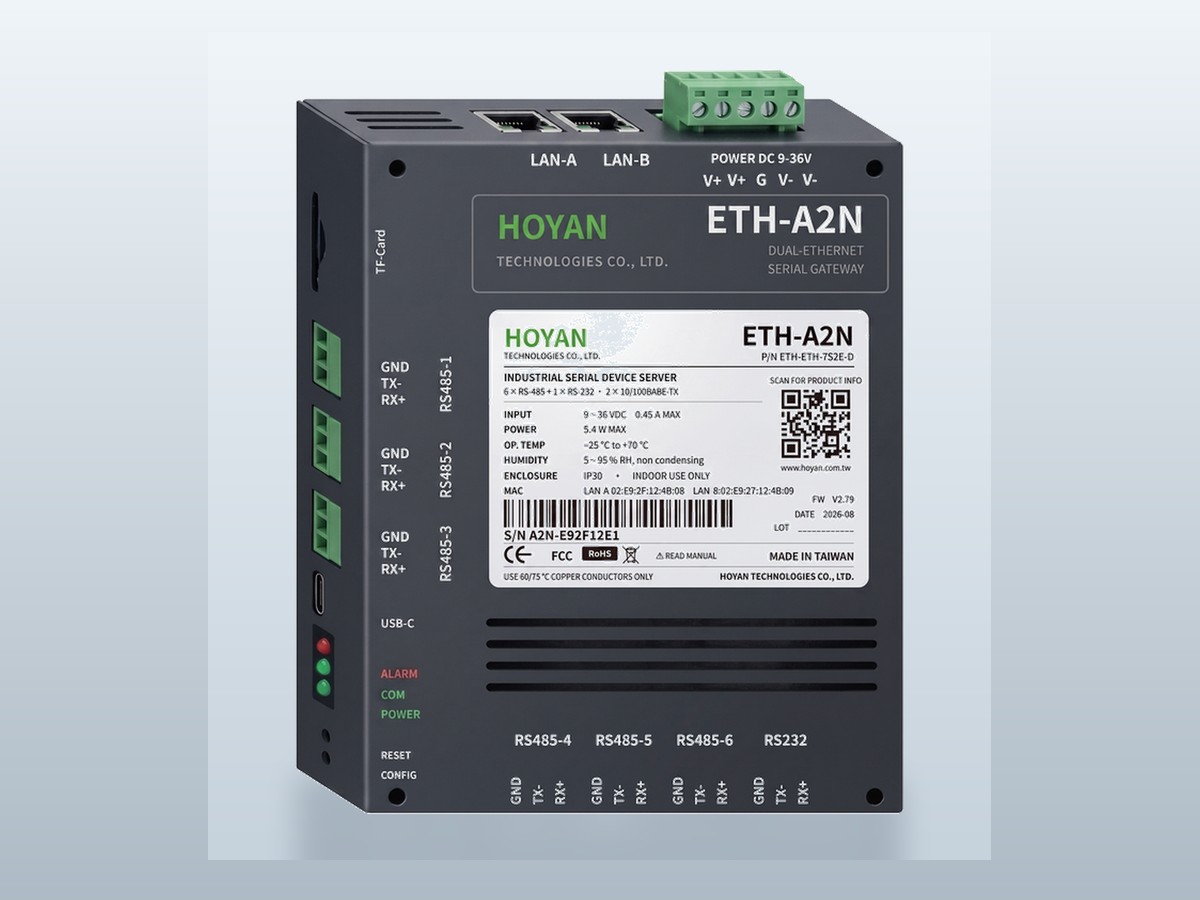
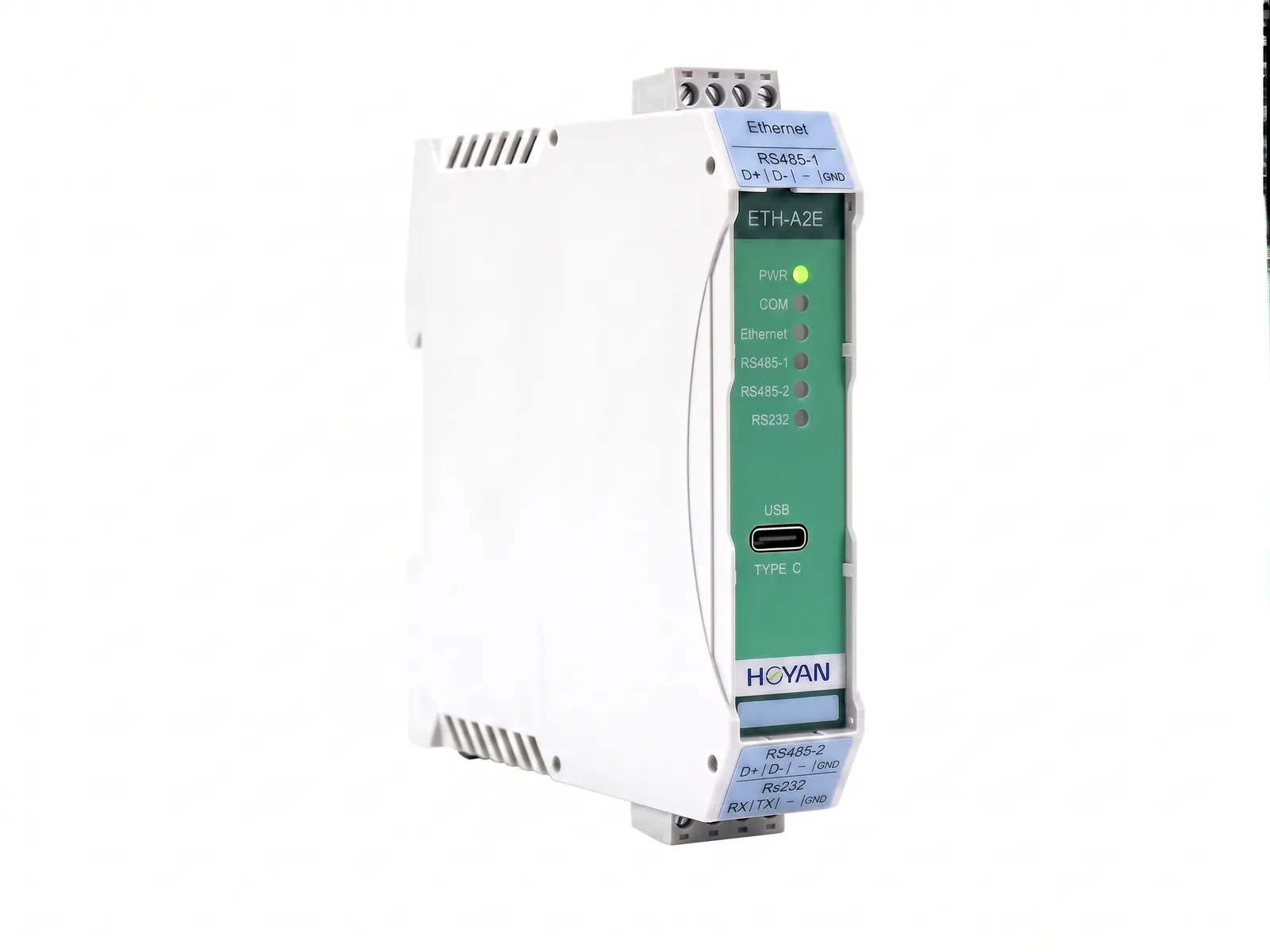
A dedicated monitoring gateway for HY-VT series triaxial vibration sensors. Six isolated RS-485 ports poll multiple sensors in parallel, and the gateway applies the built-in HOYAN-CBM criteria set to produce the ISO 10816-3 zone verdict, health score and trend statistics. Results are served over Modbus TCP to an existing SCADA, published northbound by MQTT, and offered to a local PLC as a Modbus RTU slave.
Serial interfaces6 × isolated RS-485 · 1 × RS-232
Network interfaces2 × 10/100BASE-TX · separate MACs
Criteria setHOYAN-CBM v1.1 · ISO 10816-3 zones and health score
Bearing and gear failures usually show symptoms weeks in advance, yet are found only through noise, heat or a stoppage — and unplanned downtime costs far more than the part itself. Predictive maintenance tracks the rate of degradation with quantified indicators and schedules repair before the zone becomes unacceptable, turning downtime from an accident into an appointment.
ISO 10816 / 20816
The international standard for machine vibration, judging zones A to D from RMS velocity. A shared standard is what stops a verdict from becoming a matter of opinion.
10 – 1000 Hz
The standard evaluation band, covering unbalance, misalignment and looseness. The sensor's bandwidth has to cover this range completely for the verdict to hold.
Triaxial
One mounting point covers radial and axial directions, so there is no repeat installation per axis — saving both labour and sensor count.
Architecture
Sensors, gateway and host systems
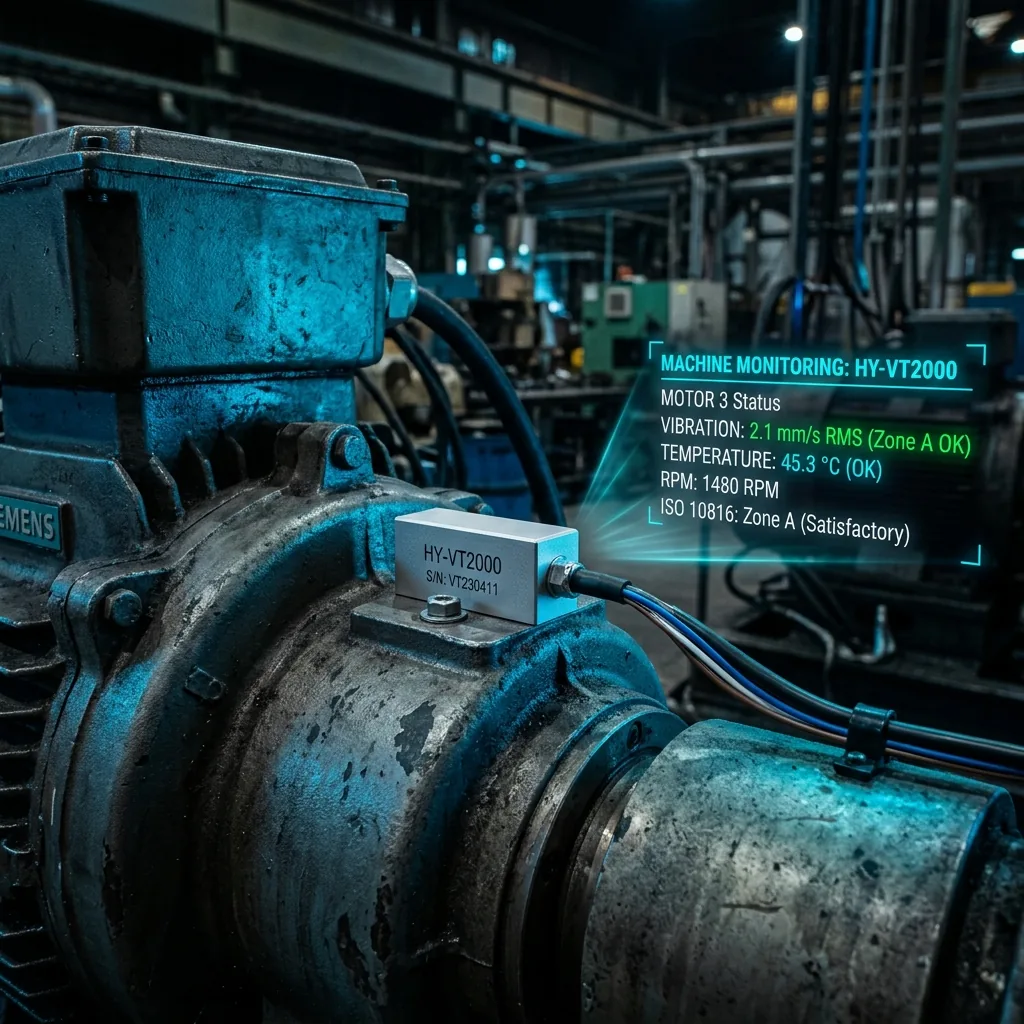
Features are computed in the sensor, the ISO verdict is made in the gateway, and host systems consume results only. Each layer does its own job, so adopting condition monitoring does not mean rewriting the monitoring logic you already run.
Design principle
The verdict is made at the edge
ISO zones and health scores are computed inside the gateway rather than handed upstream to be worked out later. That single choice drives the cost of adopting condition monitoring.
No host logic to rewrite
An existing SCADA only subscribes to results; no spectral processing logic has to be added. For a monitoring system that has been running for a decade, that is often the deciding factor.
Works when the network is down
The verdict does not depend on a cloud service or a host PC. The trend buffer and TF-card log keep accumulating through an outage, so the measurement record has no gaps.
Bandwidth spent on results
What travels northbound is zones, health scores and alarm events, not raw waveforms. Across plants or over a cellular link the difference is substantial.
HOYAN-CBM v1.1
Three-layer evaluation architecture
The ISO 10816 / 20816 series answers one question: is the overall vibration of this machine too high? It shows that a problem exists but not what it is. HOYAN-CBM adds a diagnostic layer on top of ISO and, just as importantly, states which layer is standard and which is engineering practice. The criteria set is held in internal flash and ships with the firmware — no TF card, no PC software, no extra licence.
L0 Zone verdict (basis: international standard)
Answers "how large is the vibration?" Boundary values are taken directly from ISO 10816-3 / ISO 10816-1: 12 tables and 24 boundary values, every one verifiable.
Answers "what might be wrong?" Crest factor, kurtosis, skewness and shaft-order components hint at developing faults. ISO sets no limits for these quantities, so this layer is defined by HOYAN from engineering practice — 12 rules in total.
L2 Baseline comparison (planned)
Answers "how much has it changed relative to itself?" A 168-hour learning period, released in a later firmware.
Why L1 matters
Two blind spots of the overall-level method
An early fault does not raise the overall level: small bearing spalls produce impacts that are high in peak but low in energy, so RMS velocity barely moves — which is exactly why crest factor and kurtosis exist. The second blind spot is that the same overall level can have different causes: 3.0 mm/s may be unbalance, misalignment or looseness, and shaft-order rules (1× / 2× / 0.5×) are the cheapest way to tell them apart. L1 can indicate the conditions below, but the final verdict still rests with a qualified person interpreting trends and spectra.
Evaluation priority runs: custom threshold > the zone reported by the sensor > the 12 internal tables. The sensor value always wins; the internal tables are the fallback when the network is down or no zone is reported.
ISO 10816-3 Group 1 – 4 (8 tables)
Rigid and flexible support for each group, covering large machines above 300 kW, medium machines from 15 to 300 kW, and pumps with either a separate or an integrated driver.
ISO 10816-1 Class I – IV (4 tables)
For machines with no dedicated ISO part. The classification originates from ISO 2372:1974 and is superseded by ISO 20816-1:2016, which no longer classifies machines, so setting a Group table is preferred.
Custom thresholds (unlimited)
Set from site experience, with the highest priority. The same machine type on a different foundation legitimately warrants a different figure.
Management indicator
Health score 0 – 100
The score is mapped from each machine's own ISO zone boundaries rather than an absolute mm/s figure, so machines of different groups and sizes can be compared and ranked directly. It is a HOYAN management and overview indicator; the ISO series defines no such score, and the zone verdict with expert interpretation remains decisive.
A | 100 – 85 | Good
In ISO zone A. Newly commissioned machines and machines in good condition sit here.
B | 85 – 60 | Acceptable
In zone B. Suitable for long-term operation, though the slope of the trend is worth watching.
C | 60 – 30 | Caution
In zone C. Time to schedule inspection and repair; not recommended for extended operation.
D | 30 – 0 | Unacceptable
In zone D. Vibration is severe enough to cause damage and should be addressed promptly.
Built-in interface
No installation, no licence
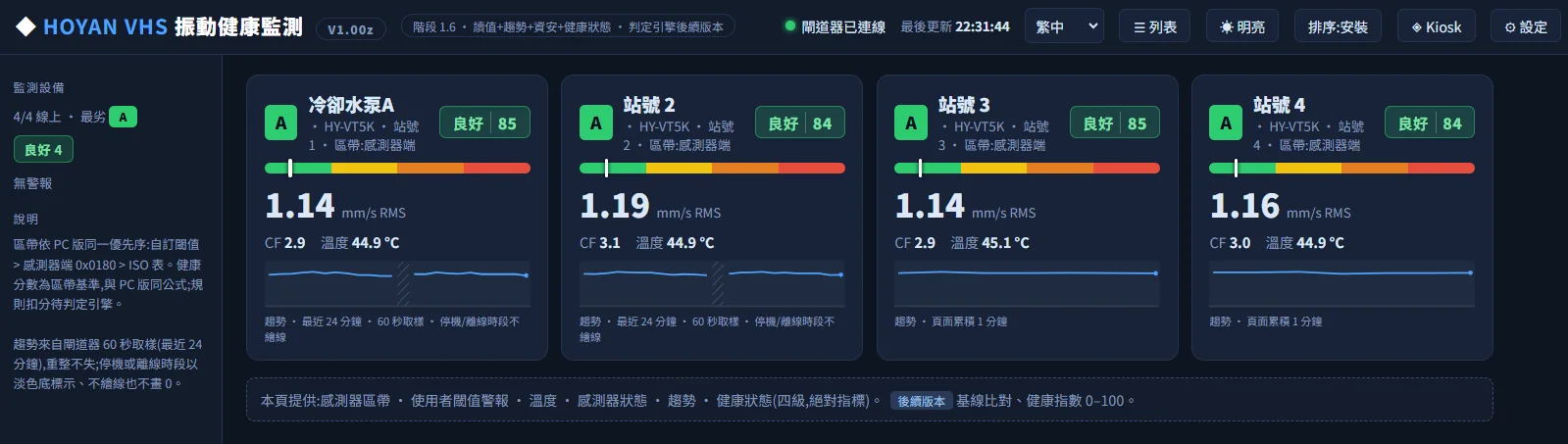
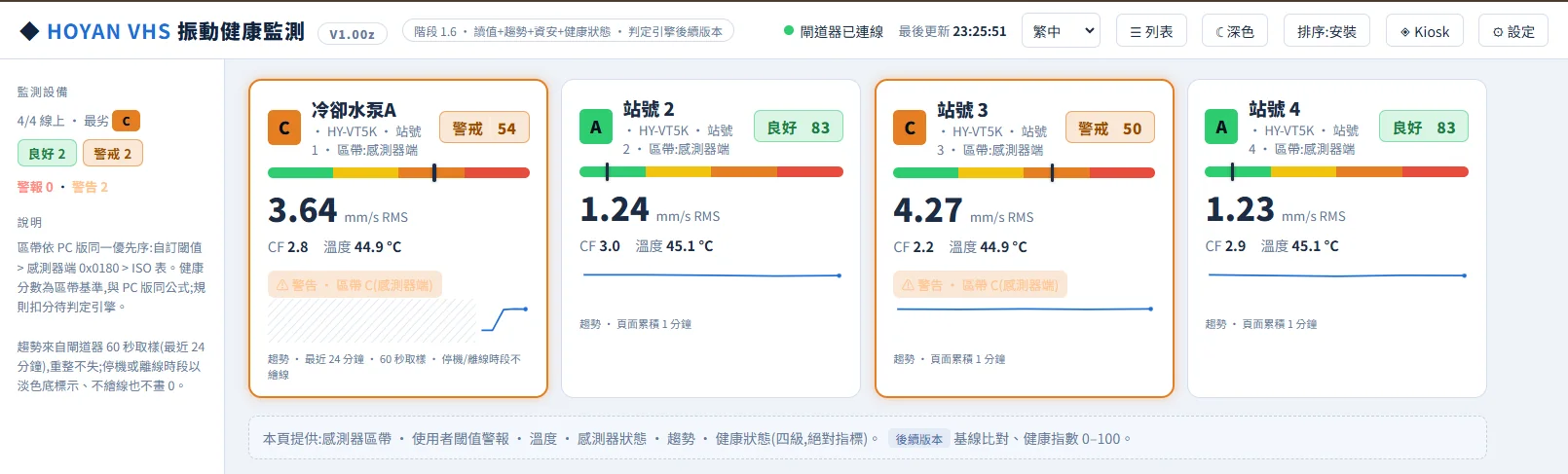
A complete monitoring web application ships inside the gateway. A browser is all that is needed for live monitoring, trend enquiry, alarm handling and configuration. Traditional Chinese, Simplified Chinese, English and Japanese switch live, dark and light themes are both available, and a kiosk full-screen mode suits a wall display on the plant floor.
Dark theme — all four machines in zone A, health score 84–85. Screenshots are from a development build; the shipping firmware governs.Light theme — two machines have fallen into zone C; the cards turn to the warning colour and show the alarm source.
Live dashboard
Each sensor shows its ISO zone, health state and score, RMS velocity, crest factor and machine surface temperature; the zone bar marks where it currently sits between A and D.
Trending
Built-in trend sparklines. Stopped or offline periods are shaded and left unconnected, so "no data" is never misread as "the level dropped".
Layout and display
Card or list view, light or dark theme, selectable sort order and a kiosk full-screen mode.
Language and status
Four languages switched live; the header shows gateway link state and last update time, so a static screen can be told from a dropped link.
Software
Three tiers of monitoring and analysis
One gateway needs only the built-in interface. Add the multi-station viewer when there are several, and the desktop application only when diagnosis is required. Each tier is added as the need appears rather than bought up front.
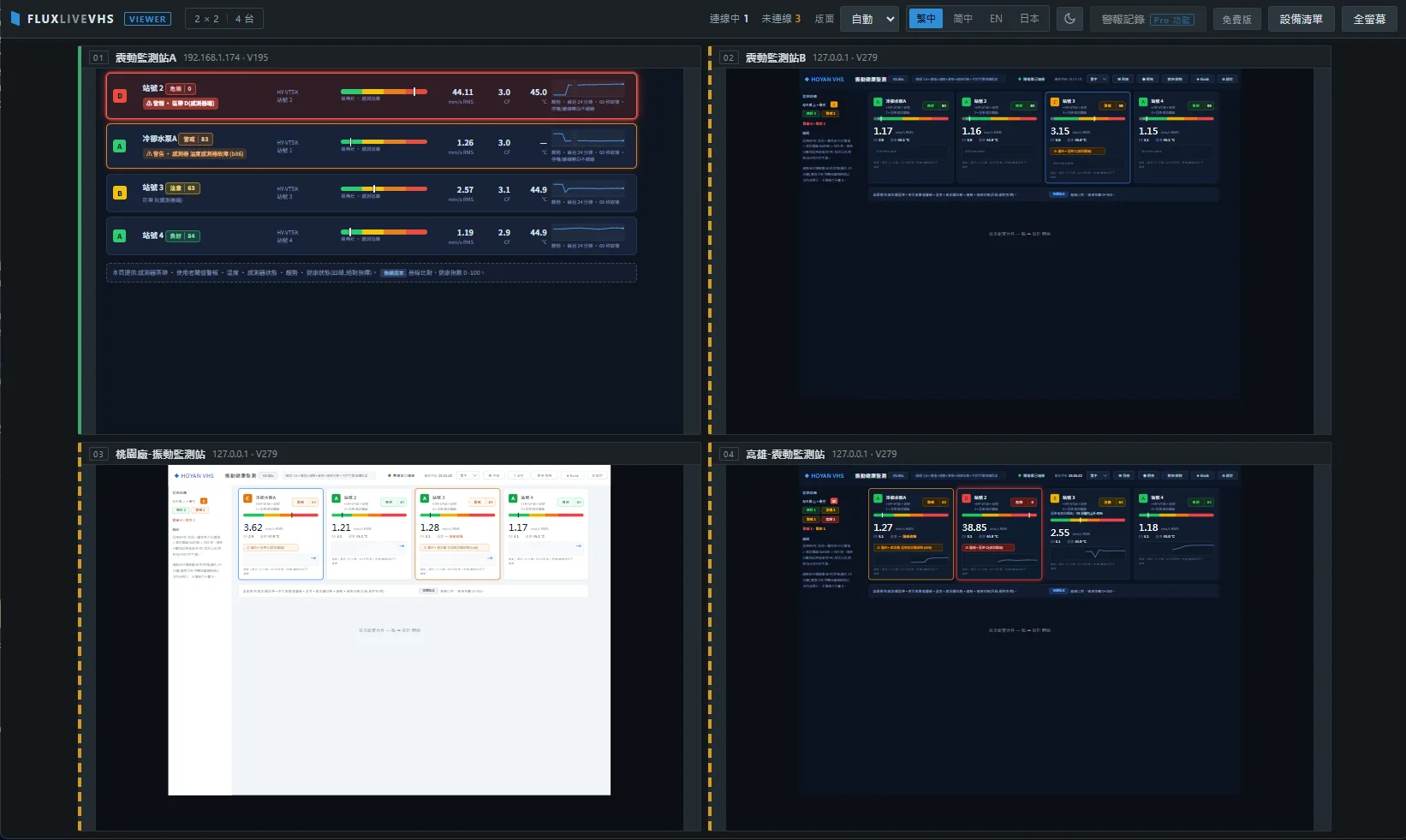
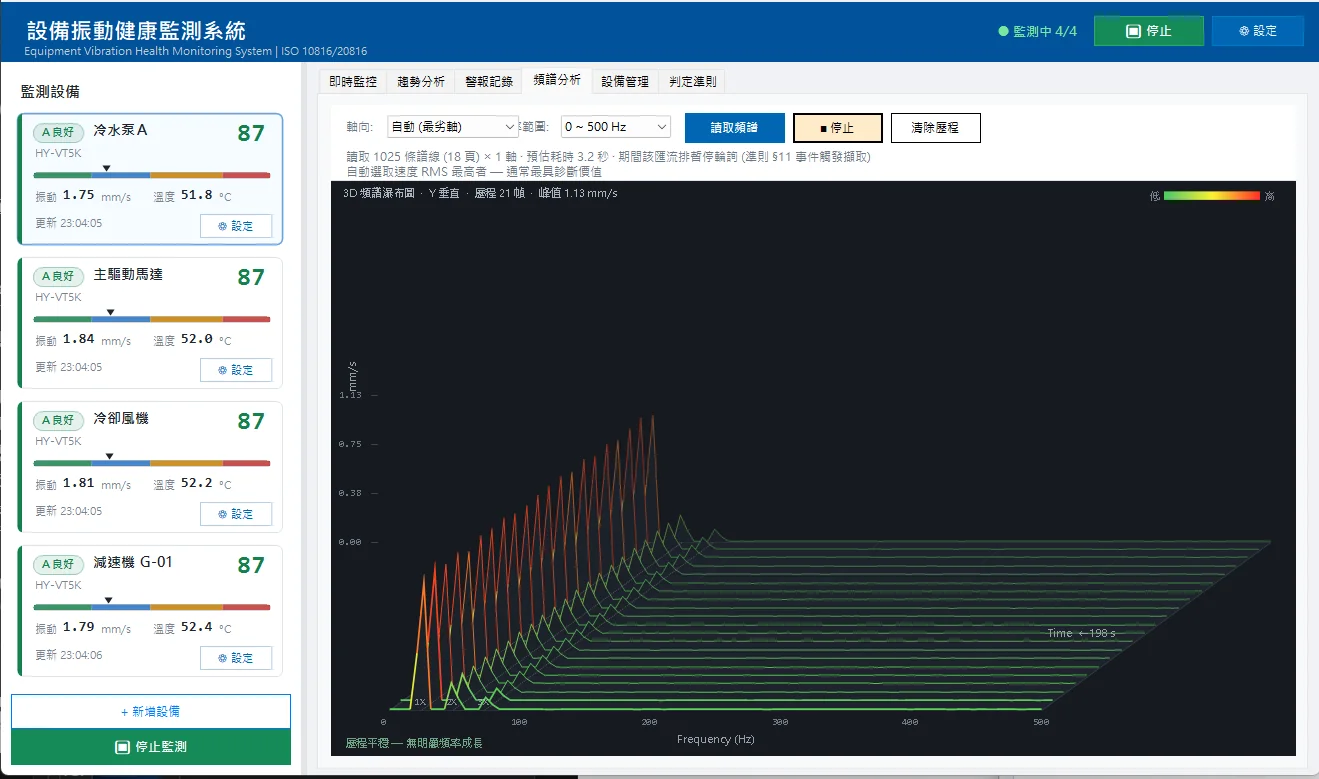
FluxLiveVHS-Viewer — four gateways on one screen; offline stations are outlined with a dashed border, and each station keeps its own card or list view and theme.VibrationHealthSystem spectrum analysis — spectral history on a 3D waterfall reveals a component growing over time. Development build.
Built-in interface (one gateway)
Shipped inside every unit and reached directly with a browser: live monitoring, trend enquiry, alarm handling and configuration. No install, no licence.
FluxLiveVHS-Viewer (many gateways)
Built on the FluxLiveCenter-Viewer architecture, it places several gateways side by side on one screen. Each tile is the live screen of that gateway itself, not a second copy of the data, so the control room and the field never hold two sets of numbers. Devices can be discovered automatically by subnet scan. A free edition is available; the alarm log and automatic zoom on critical alarms are Pro features.
VibrationHealthSystem (diagnosis)
PC-side software providing the deeper analysis the gateway does not run continuously: on-demand spectrum capture, spectral history on a 3D waterfall, long-term trending and baseline analysis. The criteria set in use is identical to the one on the gateway.
Third-party systems
An existing SCADA, PLC or MES reads the gateway verdicts directly over Modbus TCP, with no HOYAN software required.
Engineering trade-off
Spectrum capture is on demand, not continuous polling
Spectral data is far larger than feature values. Reading 1025 spectral lines by paged transfer takes about 3.2 s, during which polling on that RS-485 bus is suspended and then resumes automatically. The design keeps routine monitoring on a stable update period and spends bus time only when diagnosis calls for it. The interface states the expected duration and scope of the interruption before it starts, rather than leaving an operator to wonder why the screen froze.
Serial ports
Seven ports, each with its own role
The unit has seven serial ports (6 × RS-485, 1 × RS-232) and each is assigned one of the roles below independently, so a single gateway can act as an acquisition master and as a slave to a host at the same time. Every RS-485 port has its own schedule and buffer, so one sensor timing out or dropping off does not affect the update period of the others, and a long bus can be split across ports with different baud rates.
Sensor acquisition
Actively polls HY-VT series sensors for feature values, ISO zones and validity flags. Available on RS-485 1 – 6.
Context acquisition
Reads third-party Modbus slaves such as speed, current or temperature controllers as context for the verdict and the trend. Available on RS-485 1 – 6.
Host slave
Serves the processed condition data to an existing PLC or HMI as a Modbus RTU slave. Available on RS-485 1 – 6 and RS-232.
Bridge (transparent)
Bidirectional serial-to-Ethernet tunnelling, preserving the original serial device server function. Available on all ports and the factory default for RS-232.
Disabled
The port is switched off and excluded from the polling schedule. Available on all ports.
Integration
One gateway, two jobs
The unit inherits the ETH-A2N serial device server platform, so alongside vibration monitoring it keeps the full set of data delivery and serial integration capabilities. One gateway can send verdicts to the cloud, serve an existing SCADA by polling, and keep the original serial devices transparently connected at the same time. One data stream can reach several destinations at once, with no external splitter and without giving up the existing polling architecture in order to reach the cloud.
MQTT northbound
Publishes measured values, ISO zones, health scores and alarm events, with TLS and certificate management. For cloud platforms, IoT data lakes and cross-plant monitoring.
Modbus TCP mapping
Sensor registers are mapped into the gateway's Modbus TCP address space, so the host polls a single IP. An existing SCADA or HMI reads directly with no changes to field devices.
Modbus RTU slave
Serves processed condition data to an existing PLC or HMI over a serial port — for older plants with no network access or closed segments.
Transparent bridge
Bidirectional serial-to-Ethernet tunnelling over TCP server, TCP client or UDP. Existing serial devices go online with their protocol intact.
Cyber security
A baseline designed in the spirit of IEC 62443-4-2
Once the gateway joins the plant network it becomes part of the security boundary. These measures are enabled at the factory and need no extra setup. Passwords are never stored in clear text on the TF card or in the internal configuration.
Accounts and login
Three-tier RBAC (administrator / operator / viewer). Passwords are stored as SHA-256 with a per-account random salt, and the default password must be changed at first login. Consecutive failures trigger a lock-out with the remaining time reported, and the login banner is configurable.
Sessions and audit
Idle timeout plus absolute timeout, with a live session list and forced logout. Login, logout, lock-out, configuration change and firmware update events are all recorded.
Configuration and firmware
Configuration is written to two slots, so an interrupted write rolls back to the last complete set. OTA updates carry a backup image and recover automatically after a failed update or power loss, and the CONFIG button restores factory defaults.
Installation
Mounting and wiring
Dimensions are 105 × 118 × 60 mm excluding terminals and DIN clip, at approximately 650 g, mounted on a 35 mm DIN rail (EN 60715) or on a wall. The metal enclosure is IP30 and for indoor use only, with an operating range of −25 to +70 °C and 5 – 95 % RH non-condensing. Power is 9 – 36 V DC at 5.4 W max; the 5-pin terminal block supports a redundant dual supply, and G is the chassis earth terminal, which should be bonded to the cabinet earth bar by the shortest route. On the RS-485 side, gateway RX+ goes to sensor M12 pin 2 (A+), TX− to pin 4 (B−) and GND to pin 3; sensor power is supplied externally, the cable shield is bonded to the connector body and earthed at one point only, and 120 Ω termination is fitted at both ends of the bus. A TF card slot (microSD up to 32 GB, FAT32) and a USB-C maintenance port are provided, with POWER, COM and ALARM LEDs and RESET and CONFIG buttons on the panel.
Send us your machine list, existing SCADA and network layout. We will work out how many sensor points you need, how the gateways should be configured, and propose an architecture.